


Servo fault conditions and countermeasures
The serious damage to the servo mainly includes the following situations:;
1. The 220VAC servo is mistakenly connected to 380VAC AC power or the power grid is unstable (the power grid suddenly rises to 330VAC at night for 2-3 minutes), and the servo bus capacitor and varistor RV7 are burned out. By checking the alarm records, it is possible to quickly locate whether it was caused by a misconnection of 380VAC. In order to avoid frequent damage to the servo, it is recommended that customers add a "recovery type over voltage protector" to the servo input line . Some customers may consider adding a voltage regulator, and pay attention to confirming whether the response speed of the voltage regulator is fast enough.
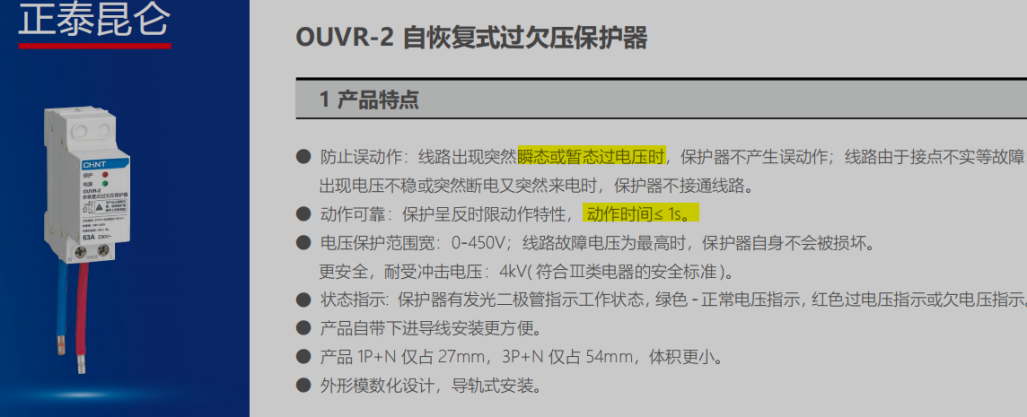
Over voltage protector (short action time)
2. There is a situation where welding machines are used on the customer's site. If the grounding wire of the welding machine has poor contact, it may cause the welding machine circuit to enter the circuit board of the driver, and the protective ground wiring on the circuit board may be burned out. For this working condition, it is recommended to insulate the servo from the iron casing of the electrical cabinet, or disconnect the shielded wires on the encoder and power lines.
3. Some customers may have leakage of A-phase live wire to the ground, causing the voltage between the AC input B-phase live wire of the servo drive and the PE iron shell to exceed 220VAC, resulting in damage to the varistor RV8. This type of problem cannot be quickly confirmed and analyzed through alarm records. A temporary alternative solution is to cut off one pin of RV8 or disconnect the iron shell of the servo drive from the ground PE . Please note that this solution is only an emergency response measure.
อ่านเพิ่มเติม
