


1. Sum of List SUM/SUMD/SUMF
ในหน้านี้6 หัวข้อ
1.1. Instruction Description#
The Sum of Single Word Lists (SUM) instruction calculates the sum of all values in a list and outputs it to RES. The Sum of Double Word Lists (SUMD) calculates double words, while the Sum of Floating Point Lists (SUMF) calculates floating points.
For example, SUM D10 D0 K5 calculates the sum of all values from D10 to D14 and stores it in D0.
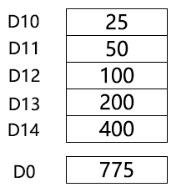
图1 Sum of List
1.2. The valid operands of the instruction#
1.2.1. Sum of Single word List(SUM)#
| Input/Output | Data Type | operand | Description |
|---|---|---|---|
| T | 16 bit integer | D | List |
| RES | 16 bit integer | D/CV/TV/AO/V/Z, bit composite word (Y/M/C/T/S), local variable (LW) | result |
| N | 16 bit integer | D/CV/TV/AI/AO/K/H/V/Z/FD, bit composite word (X/Y/M/C/T/S), local variable (LW) | length |
1.2.2. Sum of Double words Lists(SUMD)#
| Input/Output | Data Type | operand | Description |
|---|---|---|---|
| T | 32-bit integer | D | List |
| RES | 32-bit integer | D/CV, bit composite word (Y/M/C/T/S), local variable (LD) | result |
| N | 16 bit integer | D/CV/TV/AI/AO/K/H/V/Z/FD, bit composite word (X/Y/M/C/T/S), local variable (LW) | length |
1.2.3. Sum of Floating(SUMF)#
| Input/Output | Data Type | operand | Description |
|---|---|---|---|
| T | 32-bit Real Number | D | List |
| RES | 32-bit real number | D, local variable (LF) | result |
| N | 16 bit integer | D/CV/TV/AI/AO/K/H/V/Z/FD, bit composite word (X/Y/M/C/T/S), local variable (LW) | length |
1.3. Example#
Command table:
NETWORK 000
LDP X000
SUM D10 D0 K5 // Calculate the values of D10+D11+D12+D13+D14 and store them in D0.
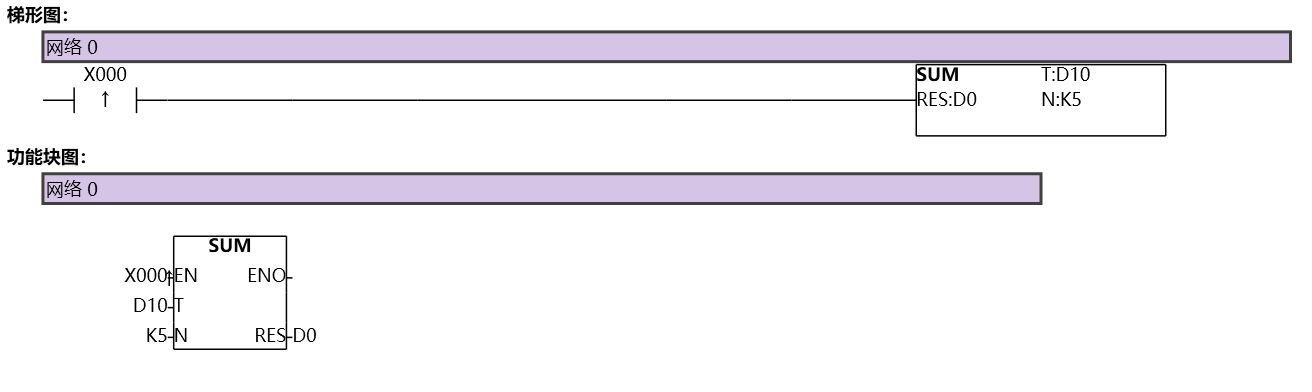
图2 SUM
อ่านเพิ่มเติม
อุปกรณ์ที่ใช้กับคู่มือนี้
2 รายการ

