


1. Program internal jump CJ/LBL
ในหน้านี้5 หัวข้อ
1.1. Instruction Description#
The jump (CJ) instruction refers to the operation of a program to jump to the program branch specified by the tag (LBL). The tag LBL instruction is used in conjunction with the CJ instruction to identify the location of the jump.
Jump instructions can be used in the main program, subroutine, or interrupt program. The jump and corresponding label instructions must be located in the same section of program code (whether it is the main program, subroutine, or interrupt program). Cannot jump from the main program to a subroutine or interrupt program, nor can it jump out of a subroutine or interrupt program.
When accepting skip connections, the top value of the stack is always logic 1.
1.2. The valid operands of the instruction#
1.2.1. jump instruction(CJ)#
| Input/Output | Data Type | operand | Description |
|---|---|---|---|
| LBL | 16 bit integer | K/H | Label |
1.2.2. jump tags(LBL)#
| Input/Output | Data Type | operand | Description |
|---|---|---|---|
| LBL | 16 bit integer | K/H | tags |
1.3. Example#
command table:
NETWORK 000
LD X000
CJ K0 // If the top value of the stack is 1, jump to the K0 tag
NETWORK 001
LD X001
ADD D0 D1 D2 // If there is no jump above, D2=D0+D1 will be executed when the top of the stack is 1
NETWORK 002
LBL K0 // K0 tags
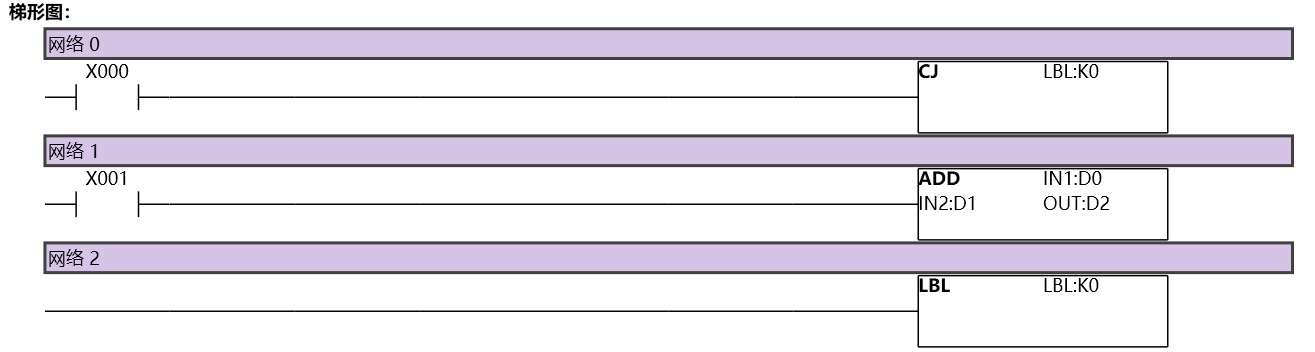
图1 CJ11
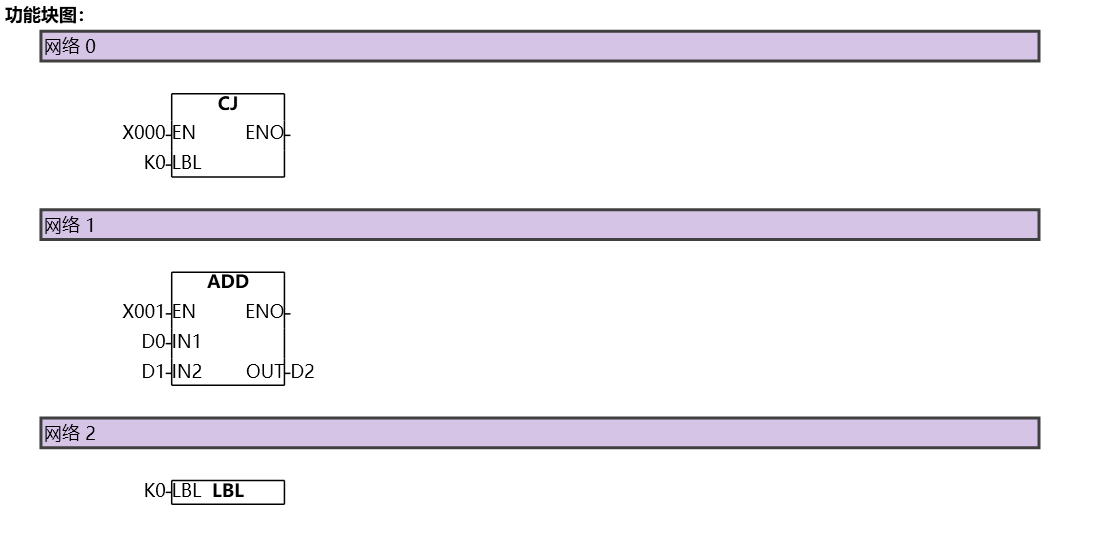
图2 CJ12
อ่านเพิ่มเติม

