


Polyline
Select the Polyline command in the
Draw menu or click the Polyline command button in the toolbar to move the mouse to the Edit window.
The mouse will change to a cross. That’s when you can draw a polyline in the
Edit window.
in the toolbar to move the mouse to the Edit window.
The mouse will change to a cross. That’s when you can draw a polyline in the
Edit window.
Move the mouse to a position where you want to draw the polyline. Click the left mouse button once, then a small green dot appears in the screen editing window, which is an endpoint of the polyline.
Move the mouse to other positions in the screen, the system will automatically draw a straight line; move the mouse to change the direction; left click once and the place where you click will appear a small green box. Here the line from the first endpoint to the first small green rectangle will not move with the mouse. The mouse can be moved to the next point to change the direction of the polyline, just click the left mouse button. When you need to complete the drawing of the polyline. Lastly right click to complete drawing the polyline, as shown in Figure 4-25:
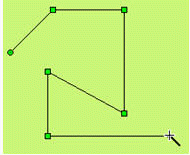
Figure 4-25 Polyline Operation
After finishing the above steps,
the transparency, line type, line width, line color, end arrow and end point
shape of the polyline will be set by default. The engineer can modify these
attributes to meet the needs of the project. Move the cursor to the polyline;
double-click the left button, or first select the line, and then click the
toolbar property button , a
dialog box same as that of Line Property will pop up.
, a
dialog box same as that of Line Property will pop up.
You can adjust the properties of the polyline using the pull-down and fine-tune buttons. The SKTOOL configuration software provides up to 6 straight line types, 30 kinds of line width, and 6 types of end arrow for polylines. To change the length, direction and position, select the line first, and then move the mouse to the polyline; hold down the left button of the mouse, after, drag the mouse to the appropriate location to release the left button.
Dynamic Color
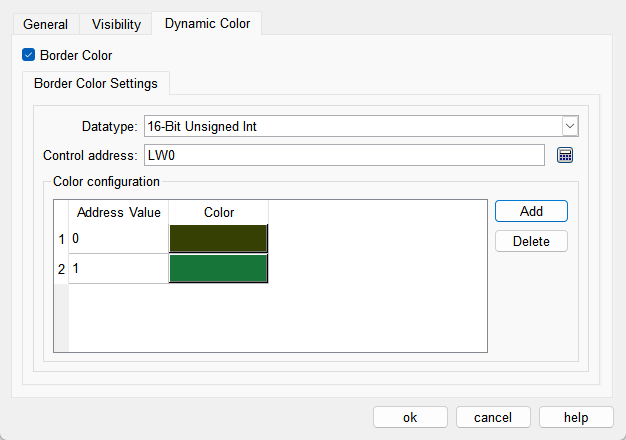
The color of border can be changed by modifying the values of the corresponding registers. You need to check the corresponding option to enable the dynamic color function.
l Data Type: Set the data type of the register.
l Control Address: Set the address of the register that controls color changes.
l Color Configuration: Multiple values and their corresponding colors can be configured. When the value of the register corresponding to the control address matches one of the configured values, the corresponding color will be displayed. (If the register value does not match any of the configured values, the color set in the configuration will be displayed.)